
Integrating the Multi-Economy Generation: A Strategic Briefing by Lucha Lunako

The Reality Check: What We Are Observing on the Ground
Over the last few years, we’ve been watching a quiet but profound shift take place across the South African workforce. It’s a reality we see daily across the entry-level corporate spectrum, particularly regarding young professionals living and operating in South African townships.
Let’s be direct: for a young professional commuting from a township to an entry-level corporate role, a starting salary is rarely just a personal paycheck. Between astronomical transport costs and extensive family financial obligations (“black tax”), that single income stream is under immense pressure.
The traditional corporate expectation of exclusivity, the idea that an employer governs 100% of an employee’s professional energy from 9 to 5, is structurally broken.
When corporate budgets tighten, and retention can no longer be bought with entry-level salary increments, we have to change the lens through which we view our talent. The most driven young professionals aren’t looking for a static job description to define their worth; they are actively building dynamic economic portfolios as a matter of resilience, survival and upward mobility.
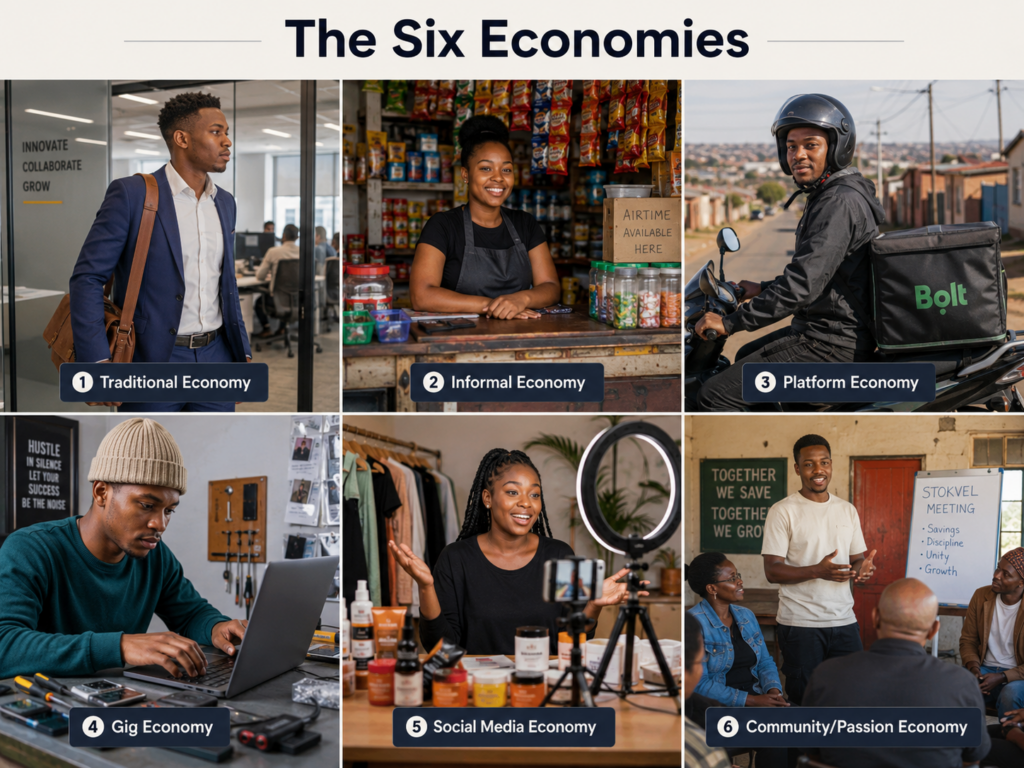
Mapping the Township Youth Portfolio: The Six Economies
When we look closely at the daily lives of entry-level township youth, they aren’t operating in a vacuum. They are fluidly navigating six distinct economic ecosystems to build a financial buffer.
- The Traditional Economy: The corporate base. It provides a formal payslip, a baseline salary and crucial corporate infrastructure (medical aid and retirement funds). However, a massive portion of this is immediately consumed by long-distance transport fares and family support.
- The Informal Economy: The sandbox of pure grit. This is a cross-the-board phenomenon. From running a weekend tuckshop or catering venture to managing a localised wholesale or sneaker-reselling via WhatsApp Business, this is where raw, high-stakes business agility and cash-flow management are learned under pressure.
- The Platform Economy: The digital bridge. Enabled by apps and global digital infrastructure (Bolt, Uber, Uber Eats, or local e-commerce distribution networks), young South Africans are leveraging platforms to monetise local assets or transport networks on weekends to patch income gaps.
- The Gig Economy: Fast-paced, project-based agility. Providing freelance IT support, phone repairs, or graphic design to local township businesses and micro-enterprises after hours.
- The Social Media Economy: Digital real estate. Utilising localised social networks and hyper-targeted digital groups to market products, build community trust and drive local consumer traffic.
- The Community/Passion Economy: The social safety net. This is less about LinkedIn personal branding and more about social capital. It involves organising community burial societies, managing local stokvels and running community-based trade groups where social capital equals absolute financial security.
- Our Collective Observation: The next generation is gaining real-world operational, supply-chain, marketing, client relations, and risk-management training on their own time, for free.

The Corporate Friction Points (And How We Must Flip Them)
In our conversations with corporate leaders, traditional management systems tend to hold rigid and outdated perspectives regarding the pace of employees’ growth trajectory, working structures and retention strategies.
Let’s look at an example of how we must strategically adjust our mindsets to drive radical retention:
Friction Point: The Internal Stagnation Trap
- The Old Corporate View: “You were hired for entry-level data entry or basic admin. Stay in your lane and wait your turn for promotion.”
- The Real-World Flip: Ambitious talent leaves when they feel boxed into a rigid, slow-moving role. Forward-thinking firms are introducing internal gig platforms or “project-based sprints”, which allow entry-level staff to spend 10–15% of their contracted time bidding on internal tasks in different departments. This satisfies the urge for variety and skill-stacking while keeping the talent securely within your payroll and culture.
Various companies like the MTN Group are investing in their future of work readiness not only by integrating ESG into their procurement transformation strategy, but also by incorporating change management, upskilling opportunities and coaching for staff.
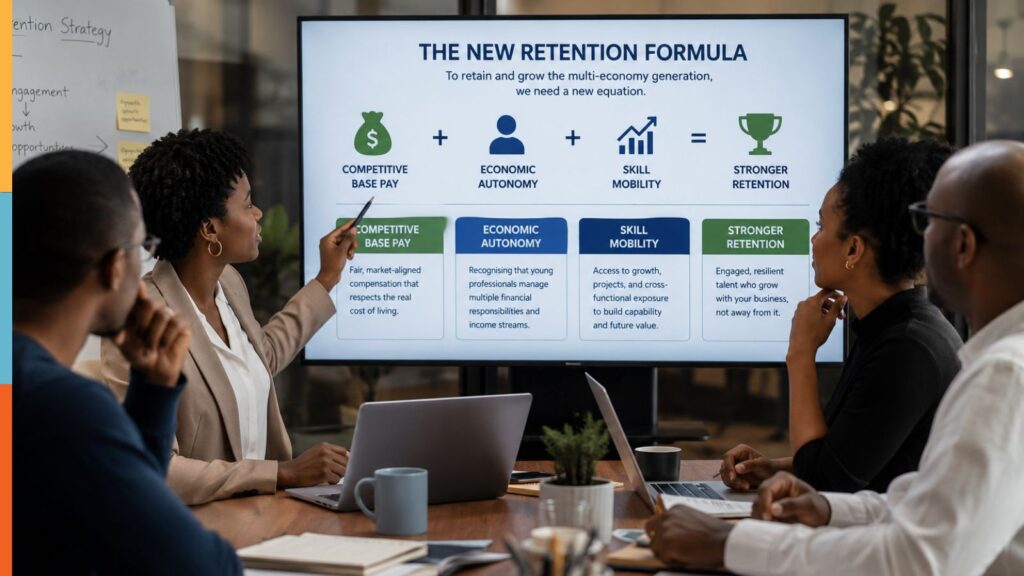
Redefining the Retention Formula Together
If our shared observations tell us anything, it’s that the metrics of retention for entry-level staff have evolved far past the 20th-century model of total exclusivity. To keep a resilient, multi-economy generation engaged, your corporate value proposition needs a structural redesign:
Retention=(Competitive Base Pay)+(Economic Autonomy)+(Skill Mobility)
At Lucha Lunako, we are right in the thick of this evolution. We are actively partnering with employers who want to stop fighting the economic tide and start leveraging it to:
- Optimise talent acquisition by aligning with the true economic and financial realities of South African youth.
- Convert talent replacement costs into strategic talent investments.
- Build workplace cultures that see active, multi-economy participation as a premium business asset, not a liability.
Read more about our work and partnership opportunities in our Organisation Profile. Our Foundations for Financial Freedom Impact Report shares our evidence-based approach to measuring impact.
Let’s Open the Floor
Look at your current standard employment contracts and HR policies. Are they still rooted in a legacy model of total exclusivity that penalises survival and drive, or do they actively leave room for the vibrant, multi-economy resilience of today’s entry-level talent?
Let’s change the narrative together. What are you seeing on the ground in your teams? Let’s keep the conversation going on our social media or you could book a call with us today.


